01
VR System Development
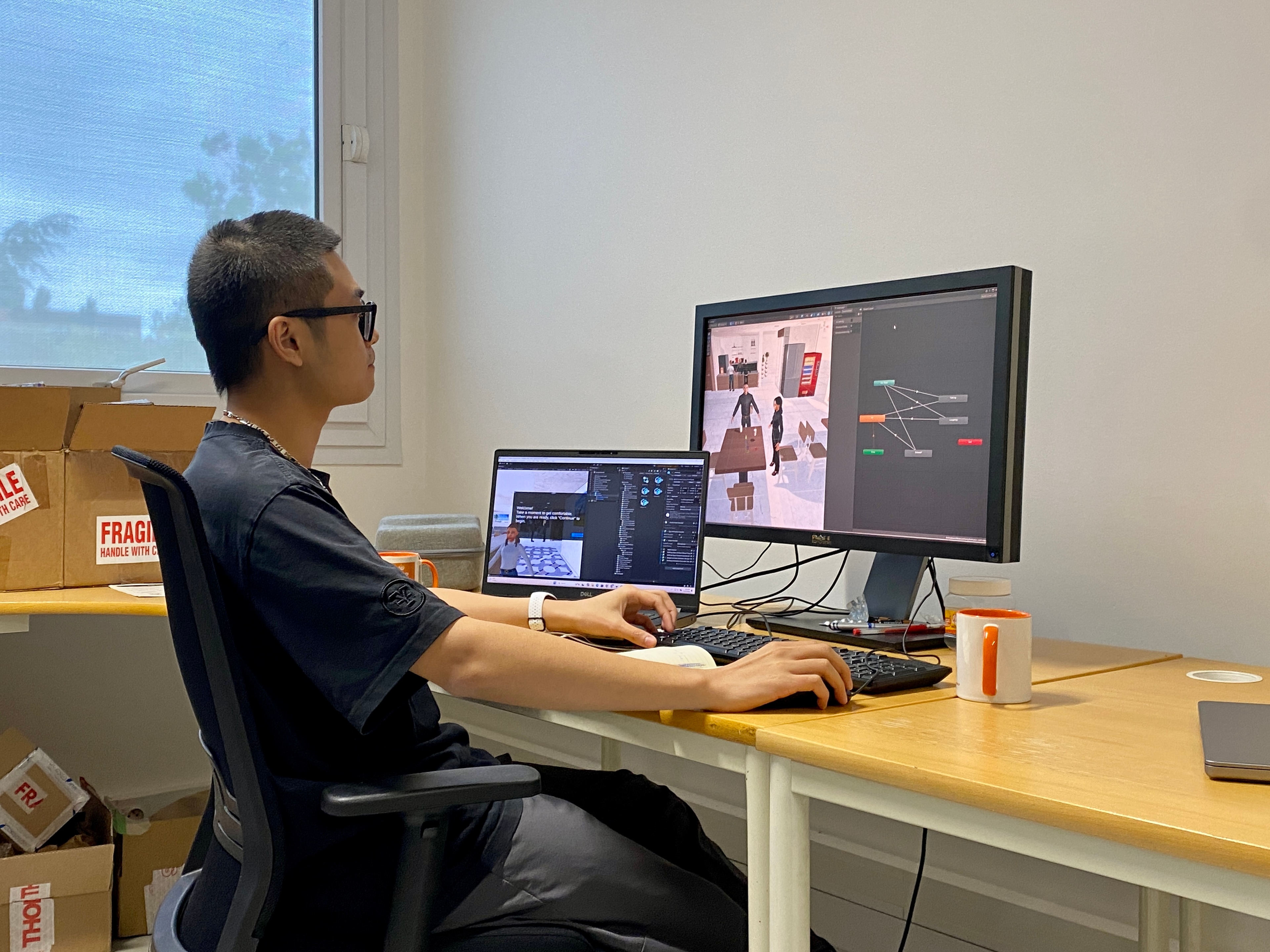
Developed and refined two Unity-based VR training conditions: one using scripted dialogue and one integrating an AI-driven conversational agent.
MSc. AIRE 1 Research Thesis · 2025
Laboratoire Interdisciplinaire des Sciences du Numérique (LISN), Centre national de la recherche scientifique (CNRS) / Université Paris-Saclay
Orsay, France
Virtual Reality · Generative AI · Soft Skills Training · Human–Computer Interaction
Supervision
Associate Professor at Université Paris-Saclay · Member of the ARAI Team at LISN, CNRS UMR 9015

StandByMe is a mixed-method research project comparing scripted and AI-driven virtual agents for workplace soft-skills training. Ten participants completed both VR conditions while behavioural, physiological, and self-reported data were collected to evaluate engagement, presence, usability, and perceived realism.
XR Researcher & Developer
MSc. AIRE 1 Research Thesis · 2025
Virtual Reality · Generative AI · Soft Skills Training · Human–Computer Interaction
Unity 2022.3 · C# · Python · Meta Quest 2 · GPT-4o · OpenAI API · ElevenLabs · Azure TTS · EmpaticaPlus
01
Developed and refined two Unity-based VR training conditions: one using scripted dialogue and one integrating an AI-driven conversational agent.
02
Integrated speech-to-text, GPT-4o dialogue generation, and text-to-speech to create dynamic and context-sensitive interactions with virtual agents.
03
Supported participant testing and analysed questionnaire, interview, behavioural, and physiological data across both experimental conditions.
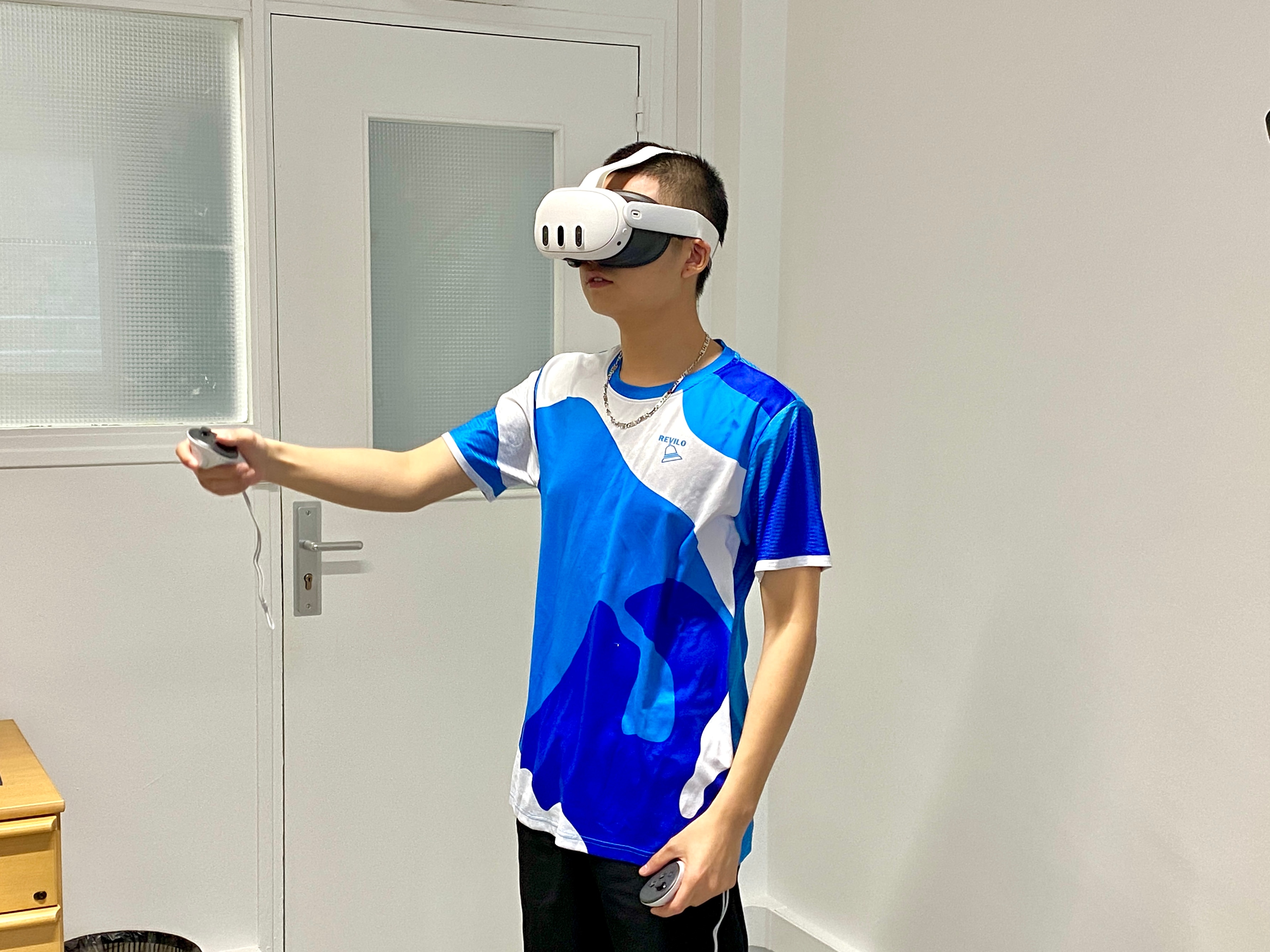
Participants experienced two counterbalanced VR conditions in immersive workplace situations where they could observe, reflect, and practise responding to challenging social interactions.
Participants
Scripted VR
AI-Driven VR
Mixed-Method Evaluation
Questionnaires · Interviews · Behaviour · Physiology
Meta Quest 2 · EmpaticaPlus
0
Ten participants completed both virtual reality conditions in a within-subject experimental study.
00
One scripted interaction and one GPT-4o-driven conversational interaction were compared.
Research Approach
Questionnaires, semi-structured interviews, behavioural observations, and physiological signals were combined to evaluate the two experiences.
Data Collection
Presence, engagement, agent perception, electrodermal activity, blood volume pulse, pulse rate, and skin temperature were collected.
Participants generally described the AI-driven agent as more natural, responsive, and engaging than the scripted interaction.
The scripted condition received higher usability ratings, while the AI condition showed slightly higher focused attention and comparable perceived reward.
Pulse rate, electrodermal activity, skin temperature, and blood volume pulse showed no significant differences between the two VR conditions.
Two virtual training experiences were developed in Unity to compare structured scripted interaction with dynamic AI-driven conversation in the same workplace-training context.
A structured VR scenario using predefined dialogue and fixed response options for workplace bystander-intervention training.
A conversational VR scenario using speech recognition, GPT-4o, and text-to-speech to support dynamic interaction with a virtual agent.